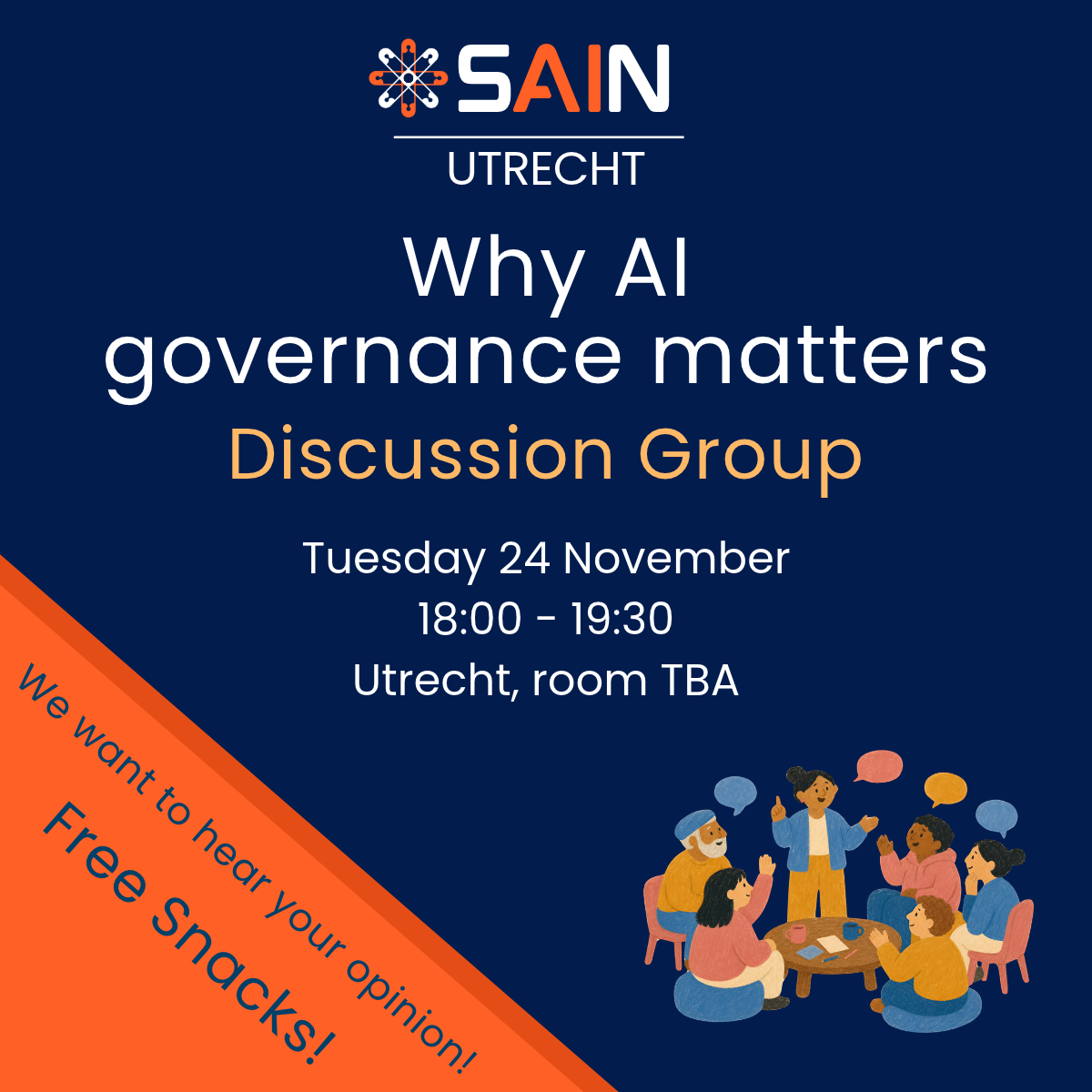
Discussion Group - Why AI governance matters
About this event
Week 1 of a four-week AI governance discussion series, alongside the SAIN Utrecht lecture course on AI governance (November–December 2026). Each session builds on the lecture of the week before, but stands on its own, so join one or all.
- Week 1 | Why AI governance matters (24 Nov)
- Week 2 | Who shapes AI governance (1 Dec)
- Week 3 | What policymakers act on (8 Dec)
- Week 4 | Europe and the Netherlands (15 Dec)
Governance or technical safety, and why now?
Last Wednesday's lecture introduced AI governance and its main risks: misuse, loss of control and concentration of power. This week we ask how governance and technical safety depend on each other: which rules can only work if a technical tool exists to check them, such as evaluations, interpretability or monitoring, and what governance adds that technical safety cannot. We also ask whether the public can see enough inside AI labs to judge the risks. We pair the lecture readings with a short Science paper by 25 leading scientists from the US, Europe and China, including Yoshua Bengio and Geoffrey Hinton, which sets out technical research and governance measures side by side.
Questions we'll explore
- Which risk worries you most: misuse, loss of control or concentration of power?
- If the technical safety problem were solved tomorrow, what would governance still need to do?
- How does a governance rule become a technical requirement? What would a lab have to measure or build to show it complies, and does that tool exist yet?
- Should outsiders be able to look inside frontier AI labs? If so, who, and with what powers?
- Does this change how seriously you take AI risk? (Either answer is welcome.)
Format (90 min): Discussion in small groups and plenary. No presentations, no wrong questions.
Who can join: Anyone curious about AI safety and governance, whether you're new to the topic, a healthy skeptic, or already deep in it. No technical background needed, and no need to have joined the lectures or earlier weeks. You don't need to have answers, just curiosity.
Readings
How to prepare: This group follows the lecture of 18 November. Please reserve about 2 hours, ideally over a few evenings. Did the lecture readings already? Skip Part 1. Short on time? The ★ items (about 1.5 hours) are the essentials.
Part 1 (~40 min): the lecture readings
- ★ ~25 min: International AI Safety Report 2026, Extended Summary for Policymakers, chapter on risks
- ★ ~15 min: METR, A proposal for better informing the public about loss-of-control risks from frontier AI development
Part 2 (~45 min): the academic lens
- ★ ~25 min: Bengio et al. (2024), Managing extreme AI risks amid rapid progress, Science. Read the whole paper; it is short.
- ~20 min: Forethought, AI-Enabled Coups: How a Small Group Could Use AI to Seize Power, summary
Part 3 (~15 min): reflection
- ★ ~15 min: note one thing that surprised you, one point where Bengio et al. and the lecture readings seem to disagree, and one governance measure in Bengio et al. that only works if a technical tool exists to check it
Attendees consent to filming and photography as participants in this event. By attending, you agree to being filmed or photographed, which may be used for social media, website, and newsletter content. If you wish to attend but do not want to be photographed, please let a member of our staff know during the event so we can accommodate this.
Source: luma